Scientific models and questions in science

We often use models to help us understand or describe scientific ideas. Models can also be used to make predictions, which can then be tested through experiments, much like hypotheses.
There are five main types of scientific models: representational, spatial, descriptive, computational, and mathematical.
Scientific Model | Description | Example |
Representational Models | These models use simplified shapes or objects to represent more complex objects in the real world. For instance, a “lock and key” model of an enzyme and the chemicals it acts on helps us to understand how enzymes work without using realistic images of the molecules involved. | In an average enzyme activity, the substrate molecules fit into an active site on the enzyme molecule. |
Spital Models | A spatial model shows the way something is arranged in a three-dimensional space, such as the way carbon, oxygen, and hydrogen atoms are arranged in a molecule | Usually, black spheres represent carbon atoms in a vitamin D molecule. The red sphere represents an oxygen atom. White spheres represent hydrogen atoms and so on. |
Descriptive Models | Descriptive models use words or diagrams to describe a concept or phenomenon. A diagram explaining the life cycle of a ladybird is an example of a descriptive model. | In that diagram, arrows would point to pictures of the “adult” phase, the eggs, the “larva phase”, and the pupa. |
Computational Models | These models use computers to simulate complex processes, such as changes in Earth’s climate. These can be images produced, for example, by a NASA climate model that predicts maximum summer temperature in the year 2100. Many places could regularly experience daytime temperatures of more than 45 degrees Celsius, which would be represented with a dark red color. | An image that shows higher temperatures in red, and cooler areas are shown in blue. |
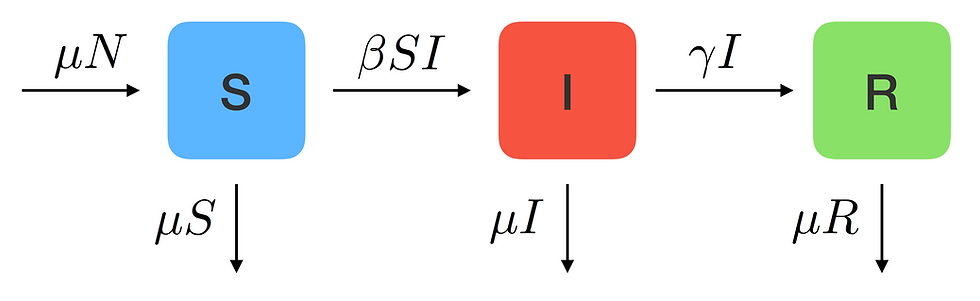
Mathematical Models | Mathematical models use maths to model processes in the real world. For example, the growth of a bacterial population in ideal growing conditions can be modeled by a mathematical equation and visualized on a graph. The model can be used to predict how many bacteria there will be after a given length of time. | A graph where the curve shows bacteria number doubling with each generation. |
Questions in science
Asking questions is a key part of the scientific process. Good scientific questions are those that can be tested by experiments or observations.
However, science also raises ethical questions — questions about what is right or wrong — which cannot be answered scientifically. These depend on people’s opinions, values, and beliefs rather than measurable evidence.
Intensive farming
Many modern farms use the latest scientific and technological methods to maximize food production — a practice known as intensive farming. This raises various questions:
Some are scientific questions that can be answered with evidence (for example, the best time to spray crops).
Others are scientific questions that cannot yet be answered due to a lack of data.
And some are ethical questions that science itself cannot address.
Questions raised by intensive farming | ||
Scientific questions that can be answered | Scientific questions that can’t be answered yet | Ethical questions |
What’s the best time of the year to spray fertilizers on crops? | What effect will climate change have on crop yield? | Should the farm change from intensive farmin g to organic farming practises? |
How might pesticides affect biodiversity? | When will genetic engineering make pesticides unnecesary? | Is growing food more important than protecting the environment? |
Animal welfare
Ethical questions often arise when biologists conduct experiments involving animals.In cancer research, for example, scientists sometimes use special strains of mice that are bred to develop cancer automatically. These mice live short lives and may suffer — raising the question of whether it is right or wrong to use them.
In many countries, strict regulations govern the use of animals in science. Researchers must demonstrate that their experiment’s potential benefits justify the use of animals, and they must always minimize suffering as much as possible.
By Iva Trpeski


Comments